

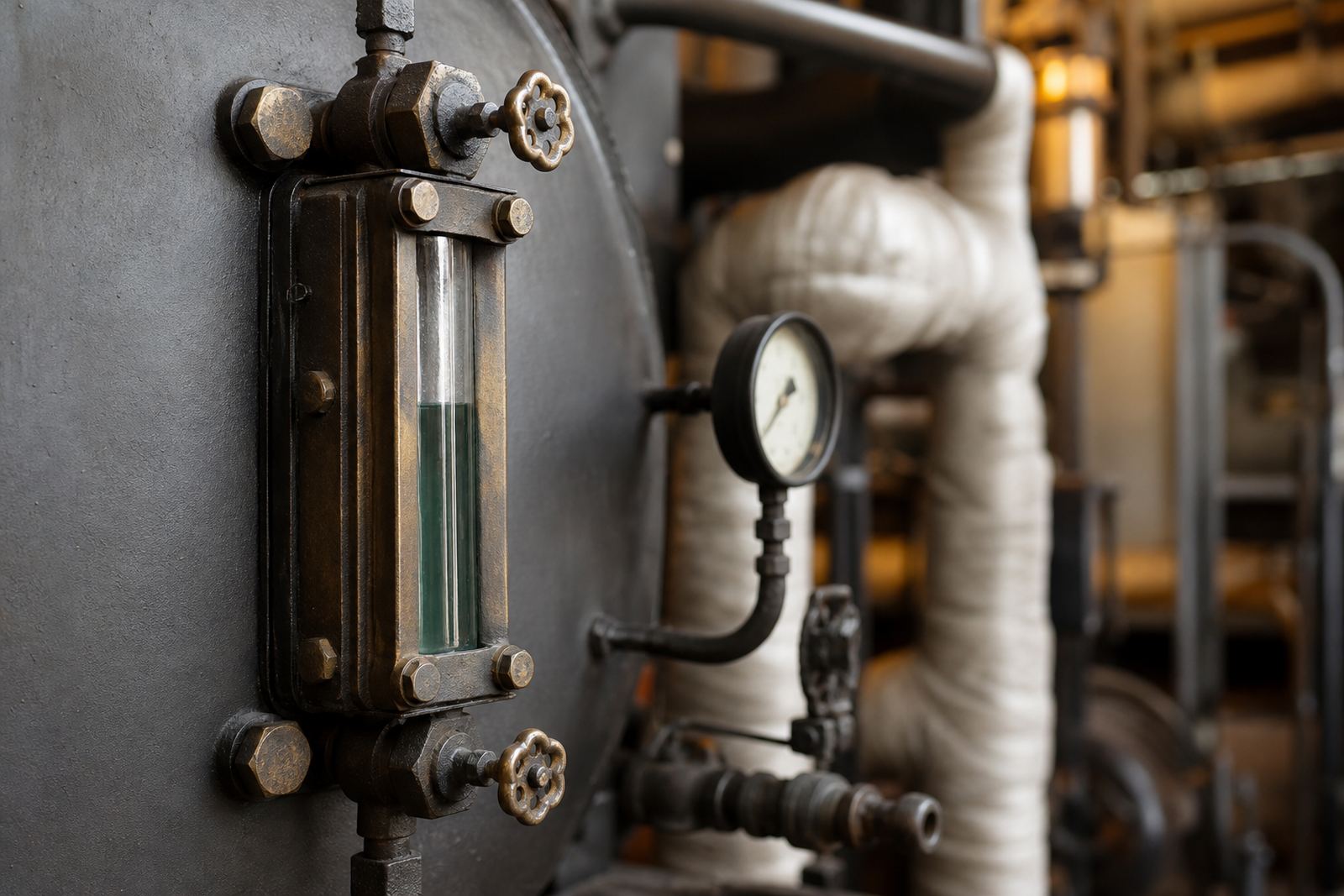
What the glass is telling you
On a steam boiler the gauge glass shows the water level inside the shell or drum through two connections, one to the steam space and one to the water space. When both connections are clear, the level in the glass moves gently with the boiler. When sludge, scale or a half-closed cock restricts one side, the level becomes sluggish or stuck, and it can read higher than the real level.
On the sites we service across Gauteng, we see this most often on boilers with poor feedwater treatment, where scale and sludge build up in the lower connection.
The shift blowdown routine
The check takes less than a minute and should be done at the start of every shift by a trained operator wearing gloves and a face shield.
- Close the water cock and open the drain, then check that steam blows freely
- Close the steam cock, open the water cock, and check that water blows freely
- Close the drain and open both cocks, then watch the level return quickly and settle
- Record the result in the boiler logbook
If the level comes back slowly, or not at all, one of the connections is restricted. The boiler should be treated as having an unconfirmed water level until it is cleared.
When to replace the glass or cocks
Glass that is etched, cloudy or chipped is harder to read and more likely to fail under pressure. Cocks that leak at the gland or are stiff to turn tempt operators to skip the blowdown. We replace glasses with the correct rated type and fit a guard where one is missing. On older boilers the cock bodies are often worn enough that a full set is the safer repair.
Linking it to the low-water controls
The gauge glass is not the only protection. Every steam boiler should have low-water alarms and a lockout that are tested on a schedule. A blocked gauge glass connection and a sticky float chamber often share the same cause, so when one shows trouble we check the other. If your operators are unsure about the routine, ask us for a site visit and a short refresher on the plant.