Why dairy heat has to stay steady
In a dairy, heat is not just about comfort or a hot tap at the wash bay. It affects cleaning cycles, sanitation timing, product consistency and how long equipment stays out of service. If the hot water drops too low during a CIP cycle, or the recovery rate is too slow, the whole line can run behind and operators start working around the system instead of with it.
Most dairy plants in Gauteng, the Free State and parts of KZN are working under pressure from water restrictions, load-shedding and tight delivery schedules. That means the heating plant has to cope with sharp demand changes without wasting diesel, gas or electricity. We often see plants where the equipment was sized for average use, not the real peak demand during cleaning, tank washdown and changeovers.
A proper dairy heat setup should support pasteurising rooms, cleaning lines, bulk tank rooms, crate wash areas and staff ablutions, while still keeping water at a stable temperature. The goal is simple: fast recovery, predictable output and fewer emergency callouts.
Typical equipment set for a dairy plant
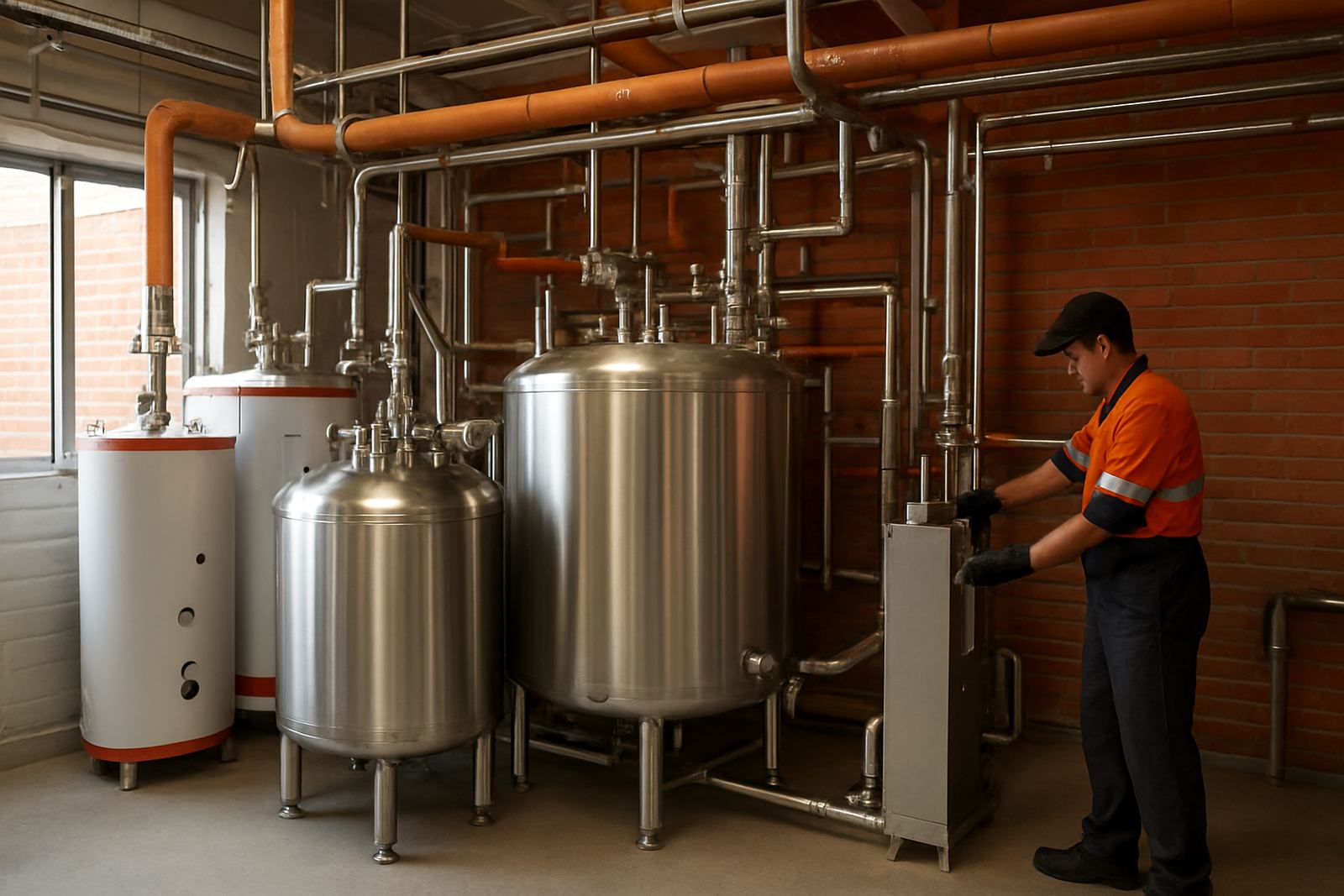
Every site is different, but most dairy plants need a mix of central heat generation and local support equipment. In many cases we specify one main boiler plant feeding hot water storage, then inline heaters or point-of-use units for remote wash points and back-up supply during peak demand.
- Commercial or industrial boilers for central hot water or steam generation
- Calorifiers for stored hot water with a steady recovery rate
- Inline heaters for fast top-up at the wash bay or remote cleaning points
- Controls, sensors and thermostats for temperature stability
- Water treatment dosing or filtration support to limit scale and corrosion
- Insulated hot water storage vessels and return lines to reduce heat loss
For dairies near the coast, salt air and humidity can shorten the life of panels, burners and pipe supports if the installation is not protected properly. Inland plants have their own issues too, especially hard water in some municipal areas where scale builds up quickly inside heat exchangers and coils. The right equipment set should match the water quality, daily wash cycle volume and the actual hours of operation.
Planning the layout around wash cycles and production flow
Good planning starts with where the hot water is needed, then works back to the plant room. If the boiler or calorifier is too far from the main use points, heat loss goes up and recovery becomes slower. If the pipe routes cross busy forklift paths or cold storage access points, maintenance becomes awkward and downtime lasts longer than it should.
We usually look at the full site layout before making a recommendation: the wash bay, process rooms, tank room, chemical storage, electrical supply and access for service teams. In older dairy plants around Boksburg, Germiston and Kempton Park, plant rooms are often tight and ventilation is poor. That matters because combustion air, flue routing and safe access for burner servicing all affect performance and compliance.
For new or upgraded sites, it helps to keep the main heat plant close to the highest demand area but away from splash zones and chemical handling areas. If the plant has to run during scheduled outages, there should be provision for generator supply, manual bypasses and a safe reset procedure so operators are not left guessing when power comes back.
- Keep plant access clear for burner service and tube inspection
- Insulate long hot water runs and return lines
- Allow space for future capacity if the plant adds another line
- Place control gear where operators can read it without entering hot zones
Common mistakes we see on dairy sites
One of the biggest mistakes is overspending on heat capacity but underinvesting in controls. A plant may have enough kilowatts on paper, yet still struggle because the temperature sensors are poorly placed, the mixing valves are wrong or the return line is losing too much heat. Another common issue is skipping water treatment until scaling becomes visible in the calorifier or heat exchanger, by which time fuel use has already climbed.
We also see boilers installed with no proper allowance for maintenance access. When a technician cannot reach the burner, sight glass, controls or refractory area easily, small faults turn into longer outages. On dairy sites, that can mean missed wash windows and production delays the next morning.
Other avoidable problems include undersized storage, poor pipe lagging, flue corrosion in damp areas and running equipment at fixed settings instead of tuning it to the real demand curve. A dairy plant should not be set and forgotten. It needs regular inspection, combustion tuning and checking of pumps, valves and safety controls.
- No water treatment plan for hard water or scale
- Poor lagging on long pipe runs and valves
- No backup plan for load-shedding or breaker trips
- Heat plant sized for average use, not peak cleaning demand
- Skipped annual inspections until a breakdown forces the issue
Budget ranges in Rand for dairy heat projects
Budget depends on plant size, fuel source, storage volume and how much refurbishment is needed on the existing system. A smaller dairy with one or two wash points may only need selective upgrades, while a busy processing site with multiple lines and long wash cycles may need a full plant-room package.
As a working guide, minor repairs, controls replacement or local heater repairs can start from about R15 000 to R45 000. A calorifier service, burner service or combustion tune with basic parts usually falls in the R8 000 to R25 000 range, depending on access and condition. Mid-sized plant refurbishment, including piping changes, insulation, safety controls and a new heating unit, often sits between R120 000 and R450 000.
For larger dairy plants needing new boiler plant, storage vessels, flue work and integrated controls, budgets commonly start around R500 000 and can move past R1,5 million where redundancy, water treatment and plant-room modifications are required. The best way to control cost is to fix the heat losses first, then match output to real demand instead of buying extra capacity that sits idle most of the day.
Maintenance that keeps dairy operations moving
Dairy heat equipment performs best when maintenance is scheduled around production, not after a breakdown. Routine servicing should include burner checks, safety device testing, inspection of seals and gaskets, coil cleaning, water treatment checks and a look at any signs of corrosion or refractory wear. If the plant runs hard through winter or during peak milk intake periods, service intervals should be tightened accordingly.
Our teams work from Jet Park, Boksburg and support sites nationally, with service coverage in Boksburg, Kempton Park, Germiston, Pretoria, Midrand and Sandton. That makes it easier to respond when a plant needs an emergency callout, a planned inspection or help after a power cut has upset the controls. We also handle plant refurbishment where older equipment is still sound but needs new piping, better controls or replacement parts to keep it useful for more years.
For dairy operators, the real value is not just in fixing faults but in preventing the next one. That means checking water quality, confirming temperature recovery times, and making sure the heat plant can keep up when the cleaning crew, the production team and the utility supply all place demand on the system at once.